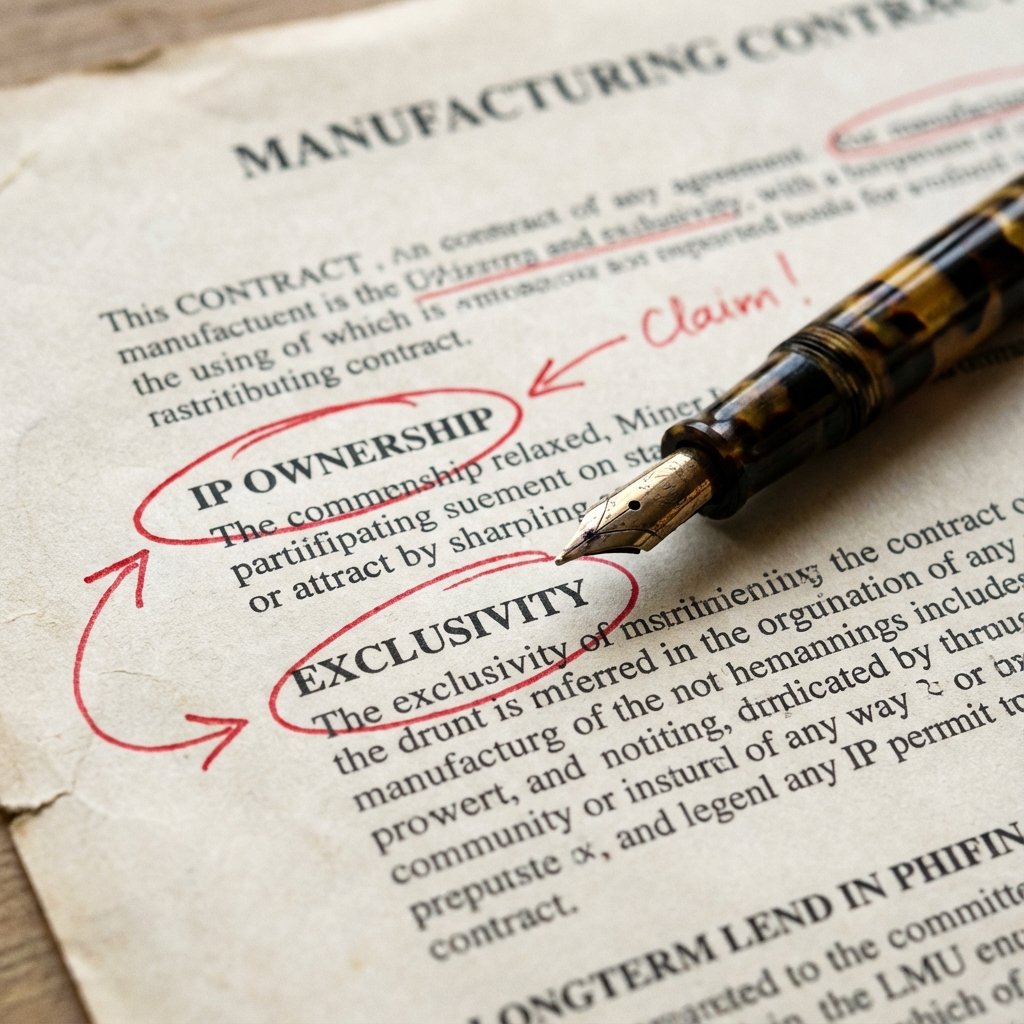
Most emerging brands start production with a Purchase Order (PO) and a handshake. This is fine for buying t-shirts. It is suicide for developing custom products.
You need a Master Manufacturing Agreement (MMA). Here are the four clauses that save you when things go wrong.
1. The "No Subcontracting" Clause
The Risk: You hire a premium factory. They get busy, so they secretly farm your order out to a cheaper, dirtier factory down the street. Quality drops, and you have no idea why.
The Clause: "Supplier shall not subcontract any portion of the Work without prior written consent from Buyer. Any authorized subcontractor must agree to be bound by the terms of this Agreement."
Why you need it: It forces transparency. You need to know exactly whose hands are touching your product.
2. The "NNN" (Non-Use, Non-Disclosure, Non-Circumvention)
An NDA is not enough. You need NNN.
- Non-Disclosure: Don't tell anyone our secrets.
- Non-Use: Don't use our molds to make products for yourself or others.
- Non-Circumvention: Don't go behind our back and sell directly to our customers.
The Horror Story: A factory uses your custom shoe mold to make "unbranded" extras and sells them on Alibaba for $10. The Non-Use clause makes this a breach of contract.
3. The "IP Ownership of Improvements" Clause
The Scenario: You send a design. The factory improves it (e.g., "If we change this zipper, it will be stronger"). You verify it and say "Great, do that."
The Trap: The factory now claims they own the new design because they invented the improvement.
The Clause: "Any modifications, improvements, or derivative works created by Supplier related to the Product shall be the sole property of the Buyer."
4. The "Mold & Tooling Ownership" Clause
The Scenario: You paid $5,000 for a custom mold. You decide to switch factories. The old factory refuses to give you the mold, saying "You paid for the usage of the mold, not the steel itself."
The Clause: "All molds, dies, and tooling paid for by Buyer are the exclusive property of Buyer and must be returned immediately upon demand, regardless of any payment disputes."
Tip: Actually stamp your company name on the steel mold. It makes it much harder for them to claim it's theirs.
Conclusion
Contracts in Asia are not just for suing people (which is expensive and hard). They are for aligning expectations. When you present a strict contract, you signal: "I am a professional. Do not mess with me."