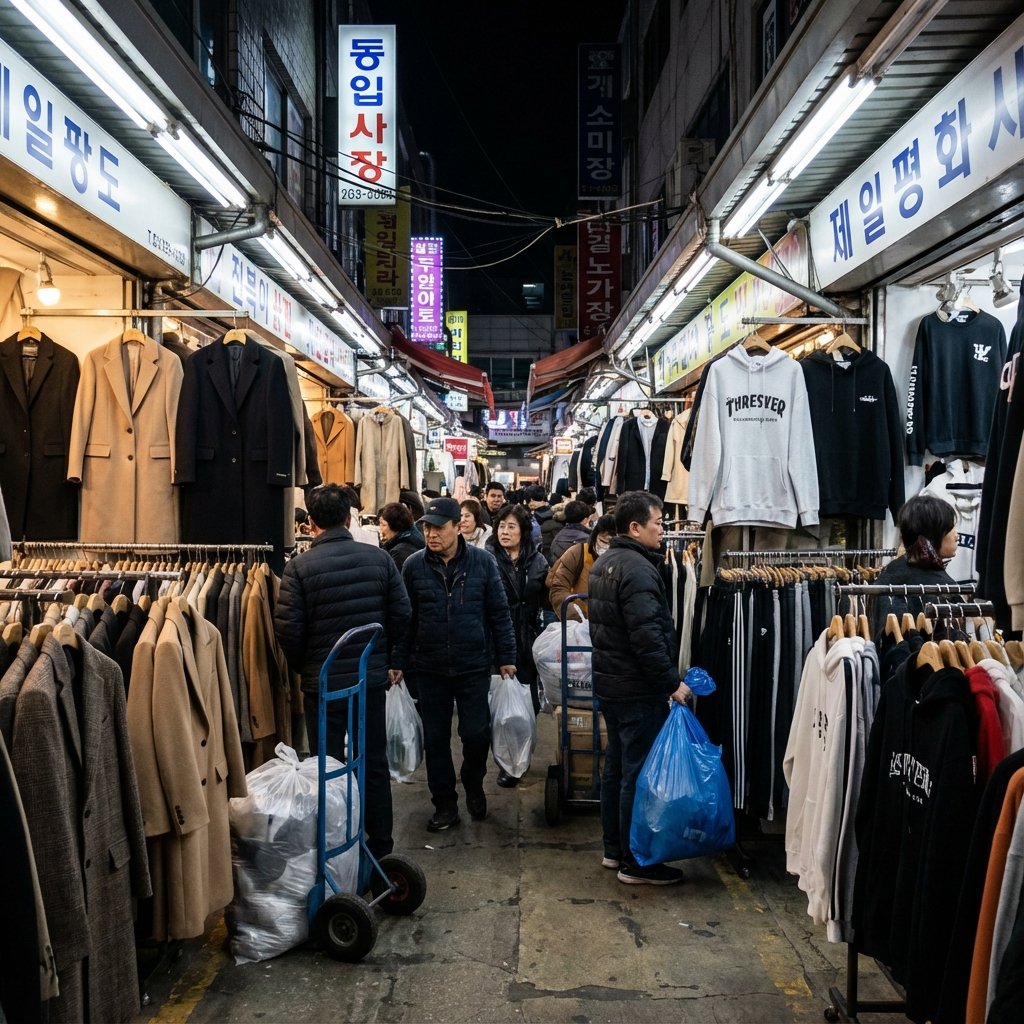
Dongdaemun Wholesale Market is one of the most distinctive fashion wholesale ecosystems in Asia. Located in central Seoul, it functions not as a single market, but as a dense, vertically integrated network combining design, sampling, small-batch production, and wholesale distribution within an unusually compact area.
To understand how Korean fashion moves from idea to market at exceptional speed, Dongdaemun is essential.
Why Dongdaemun Matters in Asian Fashion Trade
Unlike many wholesale markets that sit downstream of manufacturing hubs, Dongdaemun operates close to the design and decision-making stage.
Its importance lies in:
- Ultra-fast design-to-market cycles
- Small-batch, high-frequency production
- Direct feedback between sellers and producers
- Strong alignment with domestic retail and online trends
Dongdaemun is less about scale and more about time advantage.
A Market Built Around Speed, Not Volume
Dongdaemun’s core strength is speed.
The ecosystem enables:
- Design development overnight
- Sampling within 24–48 hours
- Immediate wholesale launch
- Rapid style replacement based on sales response
This pace is possible because designers, pattern makers, sample rooms, sewing workshops, and wholesalers operate within walking distance.
Structural Composition: More Than a Wholesale Market
Dongdaemun consists of multiple layers working simultaneously:
- Design offices and small studios generating original or adapted styles
- Sample rooms translating designs into wearable prototypes
- Sewing workshops handling short-run production
- Wholesale buildings selling to domestic and overseas buyers
Each layer feeds directly into the next, minimizing coordination friction.
Production Model: Small Batches, High Turnover
Unlike production hubs focused on large minimum orders, Dongdaemun specializes in:
- Low MOQs
- Frequent reorders
- Style iteration rather than style permanence
This model favors:
- Trend-sensitive apparel
- Women’s fashion
- Seasonal items with short lifecycles
However, it limits scalability for brands seeking stable, long-term production runs.
Pricing Structure and Cost Logic
Dongdaemun pricing reflects:
- Higher labor costs
- Small production scale
- Intensive manual processes
- Speed-driven premiums
Unit prices are typically higher than mass-production markets, but buyers accept this in exchange for:
- Trend accuracy
- Short lead times
- Reduced inventory risk
In Dongdaemun, time substitutes for volume as the primary efficiency lever.
Buyer Profile and Market Reach
Typical buyers include:
- Korean boutique owners
- Online retailers and live-commerce sellers
- Overseas resellers targeting Korean-style fashion
- Test-market buyers seeking rapid trend validation
Dongdaemun’s influence extends beyond Korea through exports to Japan, China, Southeast Asia, and overseas Korean retail networks.
Comparison with Guangzhou Wholesale Markets
Dongdaemun contrasts sharply with Guangzhou’s wholesale hubs.
| Feature | Dongdaemun (Seoul) | Shahe (Guangzhou) | Shisanhang (Guangzhou) | | :--- | :--- | :--- | :--- | | Focus | Design-led | Volume-led | Style-led | | Batch Size | Small batches | Massive volume | Medium batches | | Speed | Fast iteration | Rapid scaling | Seasonal pace | | Cost | Higher unit cost | Low unit cost | Mid-range |
Where Guangzhou optimizes for manufacturing efficiency, Dongdaemun optimizes for market timing.
Strengths of the Dongdaemun Model
- Exceptional speed-to-market
- Tight feedback loops between sales and production
- Strong alignment with consumer trends
- Low inventory exposure
These strengths make Dongdaemun particularly resilient in volatile fashion cycles.
Structural Limitations
Dongdaemun also has clear constraints:
- Limited scalability
- Higher unit costs
- Dependence on manual labor
- Vulnerability to labor shortages and rising wages
As a result, Dongdaemun is often used for trend creation and testing, not long-term mass production.
Dongdaemun’s Role in the Broader Asian Network
In the wider Asian fashion system, Dongdaemun functions as:
- A trend incubator
- A rapid prototyping hub
- A demand signal generator
Styles proven in Dongdaemun often migrate to larger production bases elsewhere for scaling.
Closing Perspective
Dongdaemun Wholesale Market is best understood not as a traditional wholesale center, but as a high-speed fashion laboratory.
Its value lies in translating trends into sellable products faster than almost anywhere else in Asia. While it cannot replace large manufacturing hubs, it complements them by providing early signals, rapid testing, and design momentum.
For buyers, brands, and analysts, Dongdaemun offers insight into how speed, structure, and proximity can reshape fashion economics.
Related Articles
- Shahe vs Shisanhang: Guangzhou Wholesale Market Comparison
- How Fabric Prices Actually Impact Garment Costs
- Why Sample Quality and Mass Production Often Differ (Coming Soon)