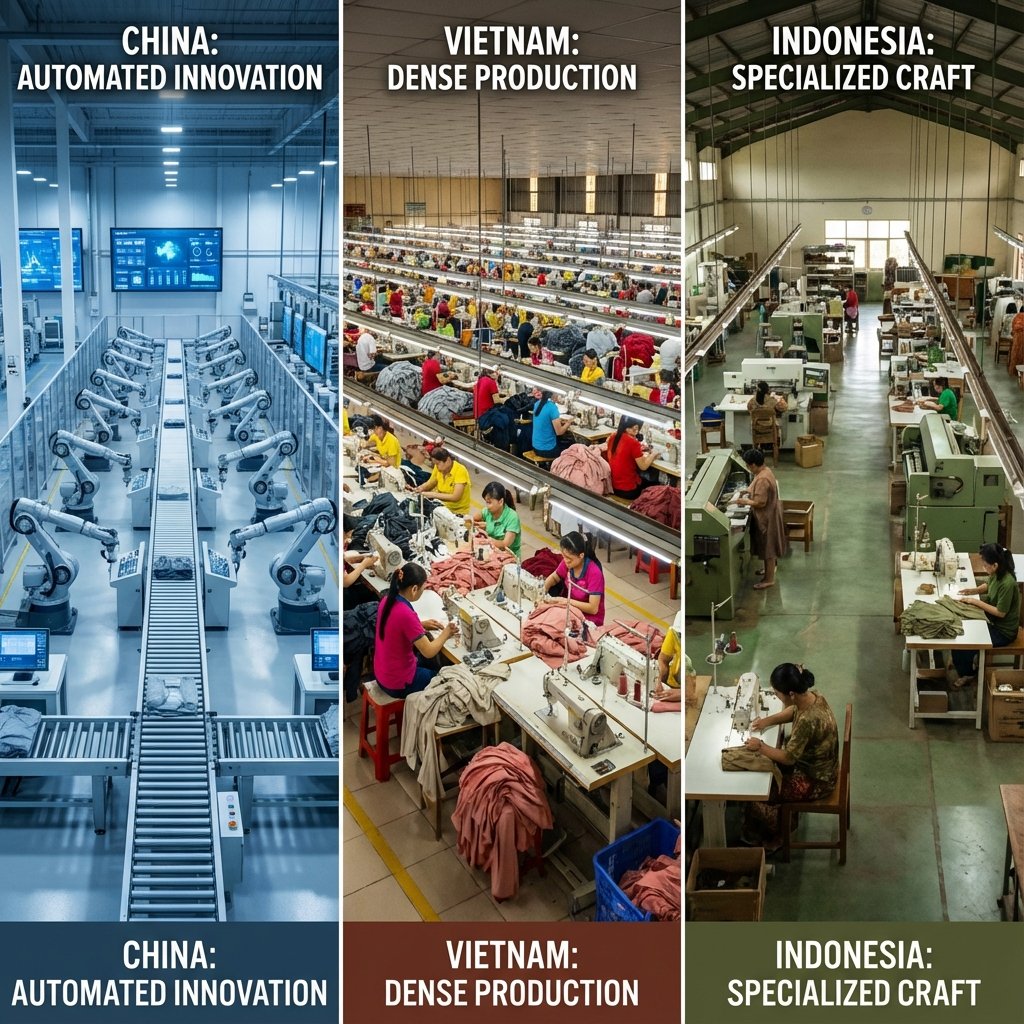
When brands consider moving production out of China, the first metric they look at is usually labor cost. On paper, the math seems simple: Vietnam creates a 30% labor saving, and Indonesia offers even more.
However, in garment manufacturing, labor rate is rarely the final cost determinant.
The "Total Landed Cost" equation includes efficiency, fabric logistics, defect rates, and lead time risks. Here is how the three major hubs actually compare when all factors are weighed.
China: The Efficiency & Ecosystem Premium
China is no longer a low-cost destination. It is an efficiency destination.
The higher labor cost is offset by:
- Complete Supply Chain: Fabric, trims, and packaging are often produced within 50km of the garment factory.
- Infrastructure Speed: Samples can be made in 24 hours; bulk fabrics arrive in days, not weeks.
- Worker Productivity: A Chinese sewing line typically outputs 15–20% more units per hour than regional competitors due to automation and skill level.
You pay more per minute of labor, but you use fewer minutes per garment.
Best for:
- Complex outerwear and technical woven items
- Orders requiring fast turns (45–60 days)
- Styles with complex fabric sourcing requirements
Vietnam: The Balanced Alternative (With a Catch)
Vietnam has successfully positioned itself as the primary alternative to China. It largely functions as an "assembly hub" rather than a fully vertical system.
The Cost Reality:
- Labor: Approx. 30–40% cheaper than China’s coastal provinces.
- Fabric Dependency: 60–70% of fabrics are still imported from China.
- Logistics Drag: Adding fabric import time adds 14–21 days to the production calendar.
The catch is that "cheaper labor" is often negated by "fabric logistics costs" unless the volume is significant. If you are shipping fabric from China to Vietnam for a small order (under 3,000 units), China is often cheaper in the end.
Best for:
- Mid-to-high volume sportswear and knits
- Brands taking advantage of Free Trade Agreements (CPTPP, EU-Vietnam)
- Stable, core programs with predictable lead times
Indonesia: Scale and Stability
Indonesia operates on a different logic: Massive scale. Factories here are often physically larger, designed for huge runs of specific categories like denim, wovens, or cut-and-sew knits.
The Cost Reality:
- Labor: Competitive with Vietnam, often more stable in rural Central Java areas.
- Lead Times: Longer than Vietnam due to geography and fabric sourcing complexity.
- Specialization: Excellent for denim (washing capabilities) and large-scale woven production.
Indonesia is rarely a "speed" play. It is a "stability and volume" play.
Best for:
- Large denim programs
- High-volume woven bottoms
- Orders planned 4-6 months in advance
The "Hidden Cost" Equation
When comparing a quote from these three countries, you must calculate the "Cost of Error" and "Cost of Time."
China Risk Profile: Low risk of delay, low risk of material shortage. High unit price. Cost of Error: Low.
Vietnam Risk Profile: Moderate risk of fabric delay (border issues). Lower unit price. Cost of Error: Moderate.
Indonesia Risk Profile: Higher risk of lead time extension. Lowest unit price at scale. Cost of Error: Low (if planned well), High (if rushed).
Conclusion: Which One Wins?
There is no single winner, only a correct fit for your specific business model.
- If you sell trend-driven fashion and need speed: Stay in China.
- If you have stable core items (t-shirts, leggings) and volume: Move to Vietnam.
- If you sell denim or heavy wovens in massive volume: Look at Indonesia.
Chasing the lowest labor rate without understanding the ecosystem usually leads to higher total costs.